
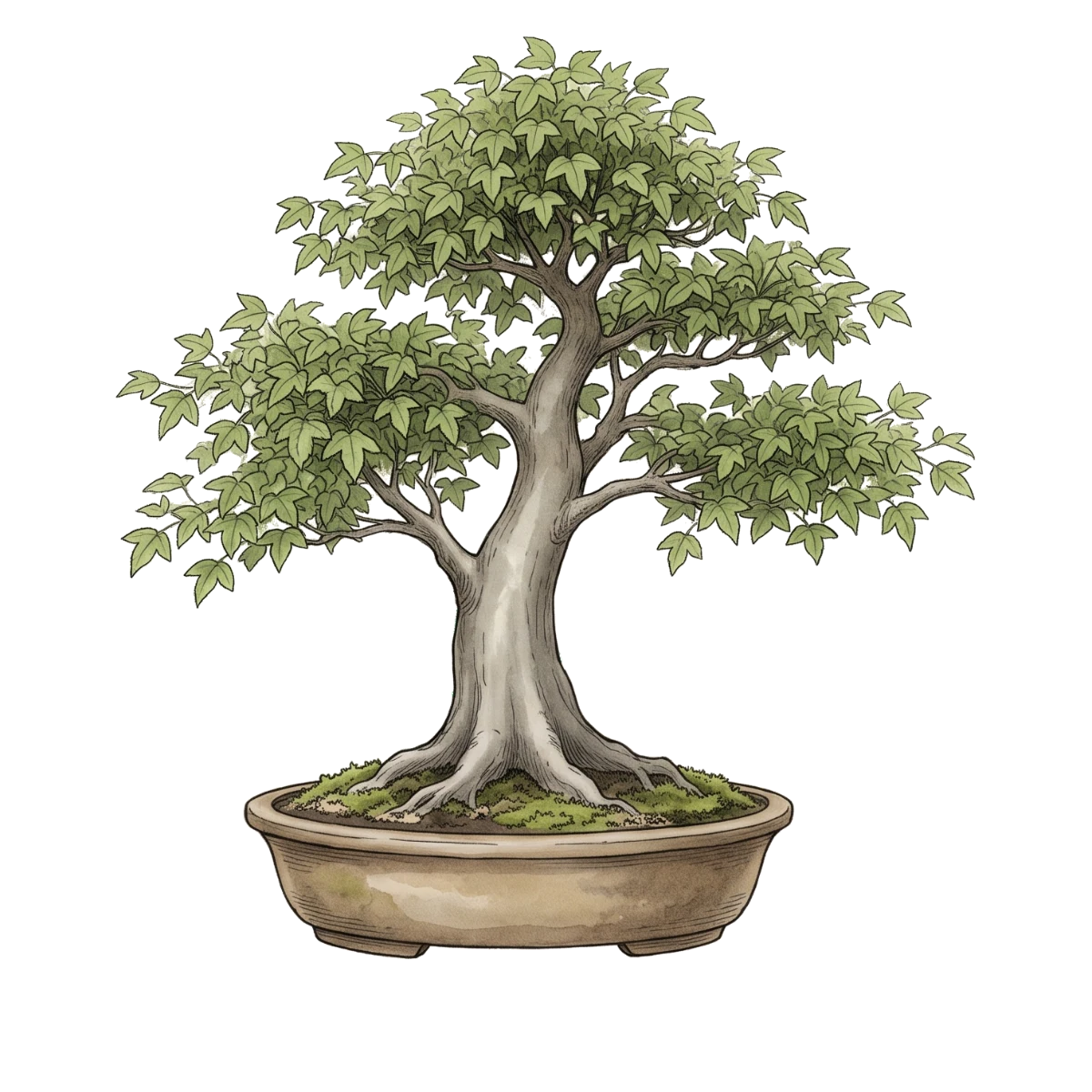
It is called trident for its three-lobed leaves. In Asia it is planted along streets because it tolerates pruning, drought and pollution, and its strong roots make it ideal for growing clasped around a rock.
At a glance
- Deciduous
- Outdoors all year round
- Sun, with shade at the height of summer
- Frost-hardy; protect the pot
- Easy care
- Main attraction: Autumn colour
- Position
- Sun in spring and autumn; in summer, shade at midday.
More detail
It needs sun so the leaves come out small and the wood ripens. In a Mediterranean high summer, protect it from midday and afternoon sun: the leaf edges scorch.
Don’t keep it indoors, not even in winter: it needs the cold to rest.
- Watering
- Don’t let it dry out completely. In summer, every day. How to water, step by step
More detail
Water thoroughly when the surface starts to dry. In heat and wind it may need watering twice a day.
If it dries out completely even once, it loses the tips of its fine branches. In winter, without leaves, much less water, but don’t let the pot dry out.
- Feeding
- In spring and autumn, at half strength.
More detail
It grows very vigorously: feed in moderation, in spring once the leaves are out and again in autumn.
With too much feed the shoots lengthen and the leaves get bigger.
- Soil
- Akadama with 20 to 30 % pumice or volcanic grit.
More detail
A soil that holds some moisture and drains well: akadama with some pumice or volcanic grit.
A little organic matter helps keep the roots cool in summer.
- Repotting
- Every 2 or 3 years, in February or March, as the buds swell.
More detail
It fills the pot with roots very quickly and needs repotting more often than other maples. Do it in late winter, when the buds start to swell.
It tolerates a hard root trim very well.
- Pruning
- Structural pruning in late winter. Touch-ups in summer.
More detail
Cuts to large branches, in late winter, before it sprouts. In summer, when it grows most strongly, you can shorten branches to balance the tree.
It tends to grow strongly at the top: keep the crown in check so it doesn’t weaken the lower branches.
- Pinching
- Let the shoot grow 3 or 4 pairs of leaves and cut it back to 1 or 2.
More detail
Its leaves grow in opposite pairs. When a shoot has three or four pairs, cut it back leaving one or two.
Repeat throughout the season. On strong, established trees, removing the big leaves in early summer reduces leaf size.
- Wiring
- Young branches, in spring or summer. It thickens fast: keep watch.
More detail
Young branches bend well. Check the wire often: it thickens quickly and marks easily.
Much of the shape is achieved by cutting and letting it grow.
- Cold
- Frost-hardy, but its roots in a pot are sensitive: protect them.
More detail
It needs winter cold and withstands frost, but its roots are more sensitive to freezing than the rest of the tree. In a pot, protect them if it is going to freeze hard for several days.
Don’t bring it indoors.
Calendar
Based on a Mediterranean climate. In colder areas, put back the spring jobs.
Over the years
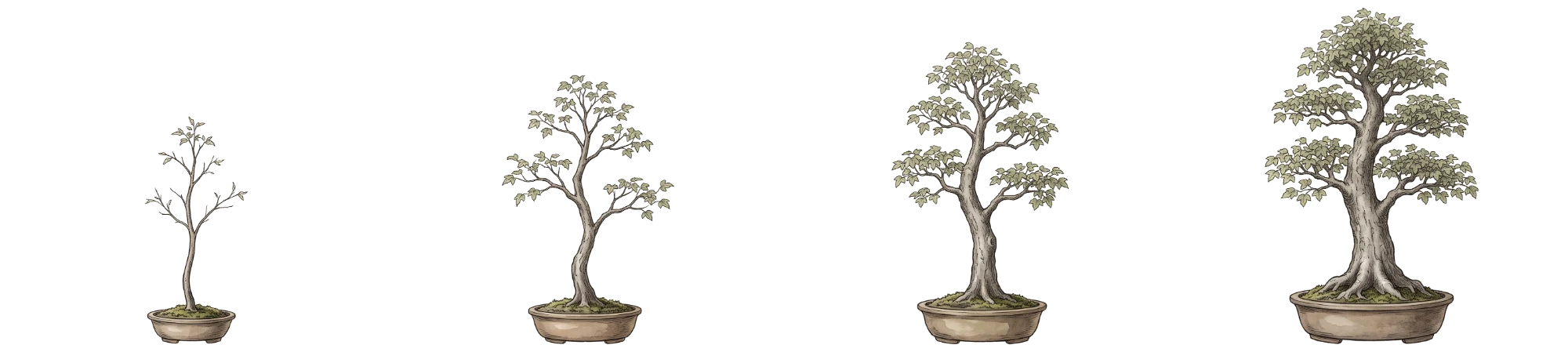
An approximate guide, assuming continued cultivation and pruning.
When you bring it home
- Unpack it today. Take the tree out of the box and remove any plastic or wrapping from the pot.
- Put it outside. Leave it in partial shade for 3 or 4 days, then move it to its permanent spot.
- Feel the soil before watering. If the top layer is still damp, wait.
- Put back any soil that has shifted. Spread it out without piling it against the trunk. It is normal for thick roots to show.
- Check it doesn’t wobble. If it moves in the pot, secure it so the roots can take hold.
- Leave it alone. For the first few weeks, don’t repot, prune or feed it.
If something looks wrong
Powdery mildew: white powder on the leaves with poor ventilation. Thin out the canopy.
Leaf scorch: dry edges from strong sun or lack of water in summer.
Aphids: colonies on the young shoots, with curled leaves and honeydew.
If in doubt, ask before treating.
With dogs and cats No reliable data
It isn’t on the ASPCA plant list, so there is no reliable information on whether it is toxic. To be safe, keep it where your dog or cat can’t chew it.
Source: ASPCA, toxic and non-toxic plants for dogs · ASPCA, toxic and non-toxic plants for cats. Checked on 17 November 2026.