
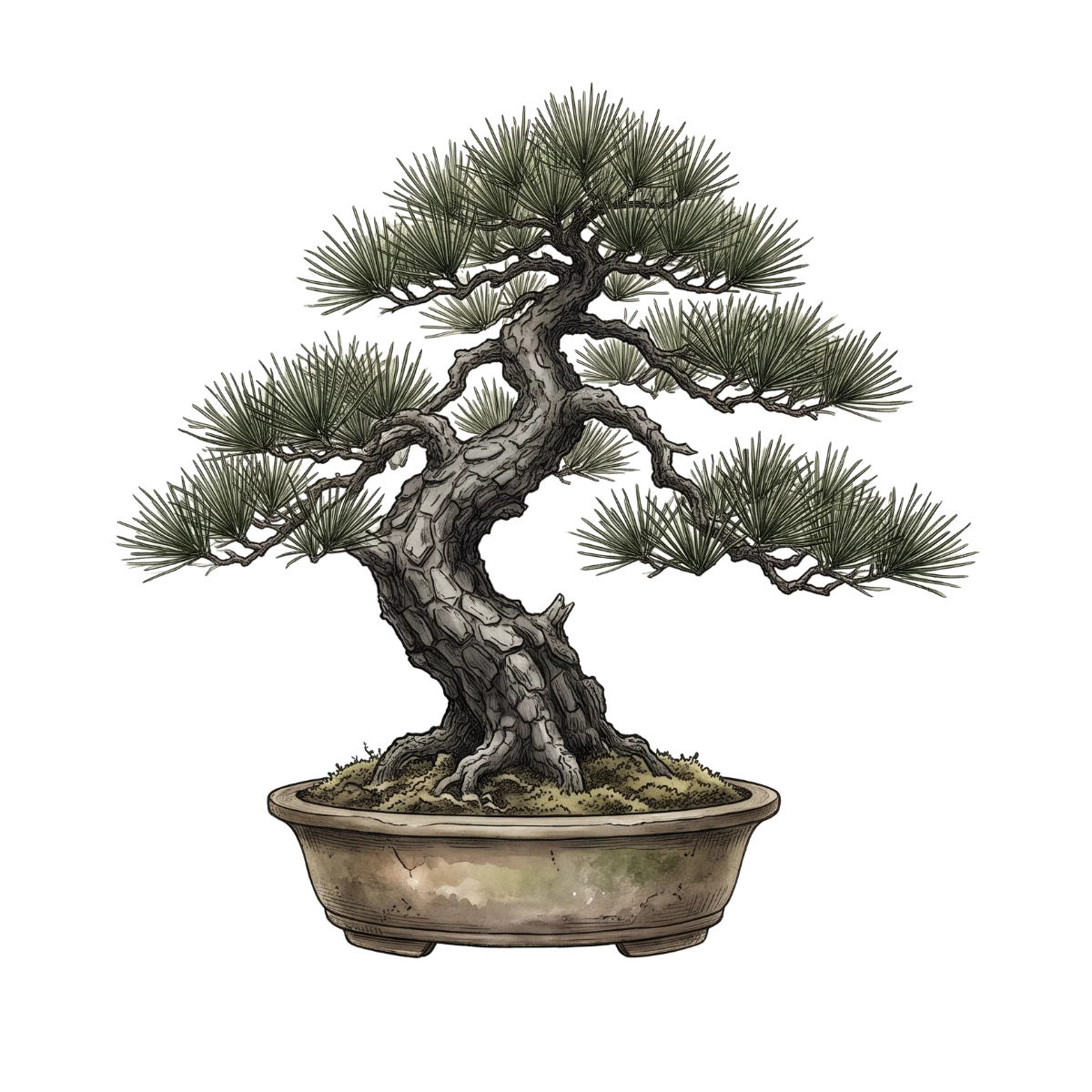
- Position
- Outdoors and in full sun all year round: it is one of the most light-hungry species.
More detail
It needs direct sun all day. In low light the needles lengthen, the interior dies back and the tree loses vigour.
It copes very well with heat and wind; it is a coastal pine. Never keep it indoors.
- Watering
- When the surface dries. No waterlogging. How to water, step by step
More detail
Water thoroughly when the top layer is dry and let it drain well. It would rather be a little short of water than have its roots always wet.
Beneficial fungi (mycorrhizae) live on its roots, and too much water damages them.
- Feeding
- Plenty in spring if it is in training; little if it is established.
More detail
A young pine in training benefits from generous feeding from early spring to build strength. An established one needs less, so the needles stay short.
Solid organic fertilisers, in pellets on the soil surface, are the most widely used.
- Soil
- Very free-draining: akadama with pumice and volcanic grit.
More detail
It needs a very airy soil that dries well between waterings: akadama with pumice and volcanic grit, or kiryu.
Fine, damp soil rots its roots.
- Repotting
- Every 3 to 5 years, in spring, as the buds start to move.
More detail
It doesn’t need frequent repotting. Do it in early spring, when the buds start to lengthen.
Don’t remove all the old soil: keep part of the root ball with its white mycorrhiza, which helps it recover.
- Pruning
- In autumn and winter, always leaving needles on every branch.
More detail
Branch cuts and bud thinning are done from when the summer shoots harden, in autumn, until late winter.
Never leave a branch without needles: pines don’t regrow from bare wood.
- Pinching
- On a strong tree, cut the spring shoots in early summer.
More detail
On a healthy pine already in refinement, in late spring or early summer the new spring shoots are cut at their base. In their place two or more summer shoots grow, shorter and with smaller needles.
In autumn these shoots are thinned to two, and the old needles are removed to let light in. Don’t do this on a weak or young pine.
- Wiring
- From autumn to early spring. Protect it from frost if it is wired.
More detail
The best time is from when the summer shoots harden, in autumn, until the buds move in spring.
Use copper or aluminium wire and bend gently. If it freezes hard, protect freshly wired trees.
- Cold
- Frost-hardy. In a pot, protect the roots if it freezes hard for several days.
More detail
It is very cold-hardy and should spend the winter outside. Only in hard, long frosts is it worth sheltering the pot.
Don’t bring it indoors.
Calendar
Based on a Mediterranean climate. The date for cutting the shoots varies with the climate.
Over the years
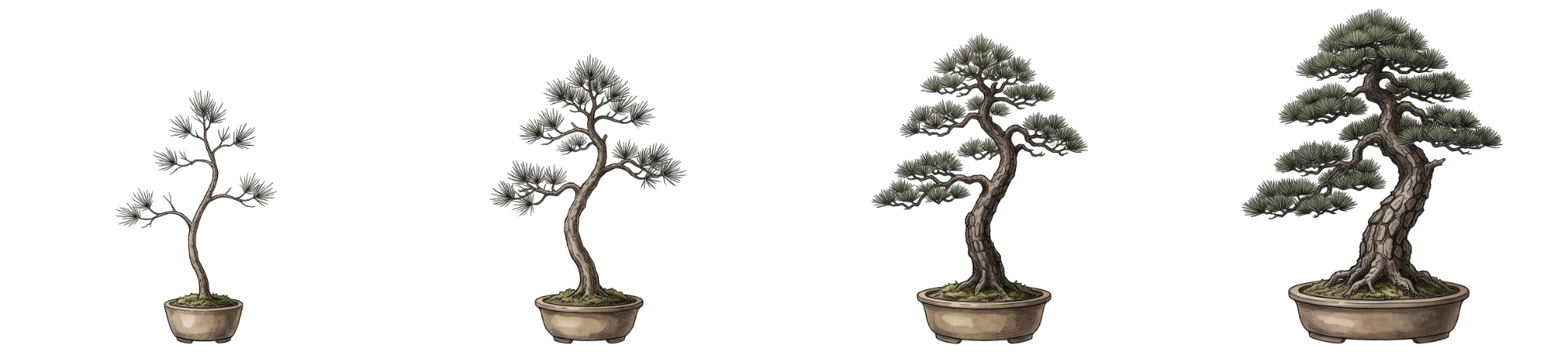
An approximate guide, assuming continued cultivation and pruning.
When you bring it home
- Unpack it today. Take the tree out of the box and remove any plastic or wrapping from the pot.
- Put it outside. Leave it in partial shade for 3 or 4 days, then move it to its permanent spot.
- Feel the soil before watering. If the top layer is still damp, wait.
- Put back any soil that has shifted. Spread it out without piling it against the trunk. It is normal for thick roots to show.
- Check it doesn’t wobble. If it moves in the pot, secure it so the roots can take hold.
- Leave it alone. For the first few weeks, don’t repot, prune or feed it.
If something looks wrong
Overwatering: yellow needles and a weak tree. Improve drainage and water less often.
Aphids and scale: colonies on the shoots or small white bumps on the needles, with honeydew.
Not enough light: long needles, a bare interior and weakening branches.
If in doubt, ask before treating.
With dogs and cats No reliable data
It isn’t on the ASPCA plant list, so there is no reliable information on whether it is toxic. To be safe, keep it where your dog or cat can’t chew it.
Source: ASPCA, toxic and non-toxic plants for dogs · ASPCA, toxic and non-toxic plants for cats. Checked on 17 November 2026.