
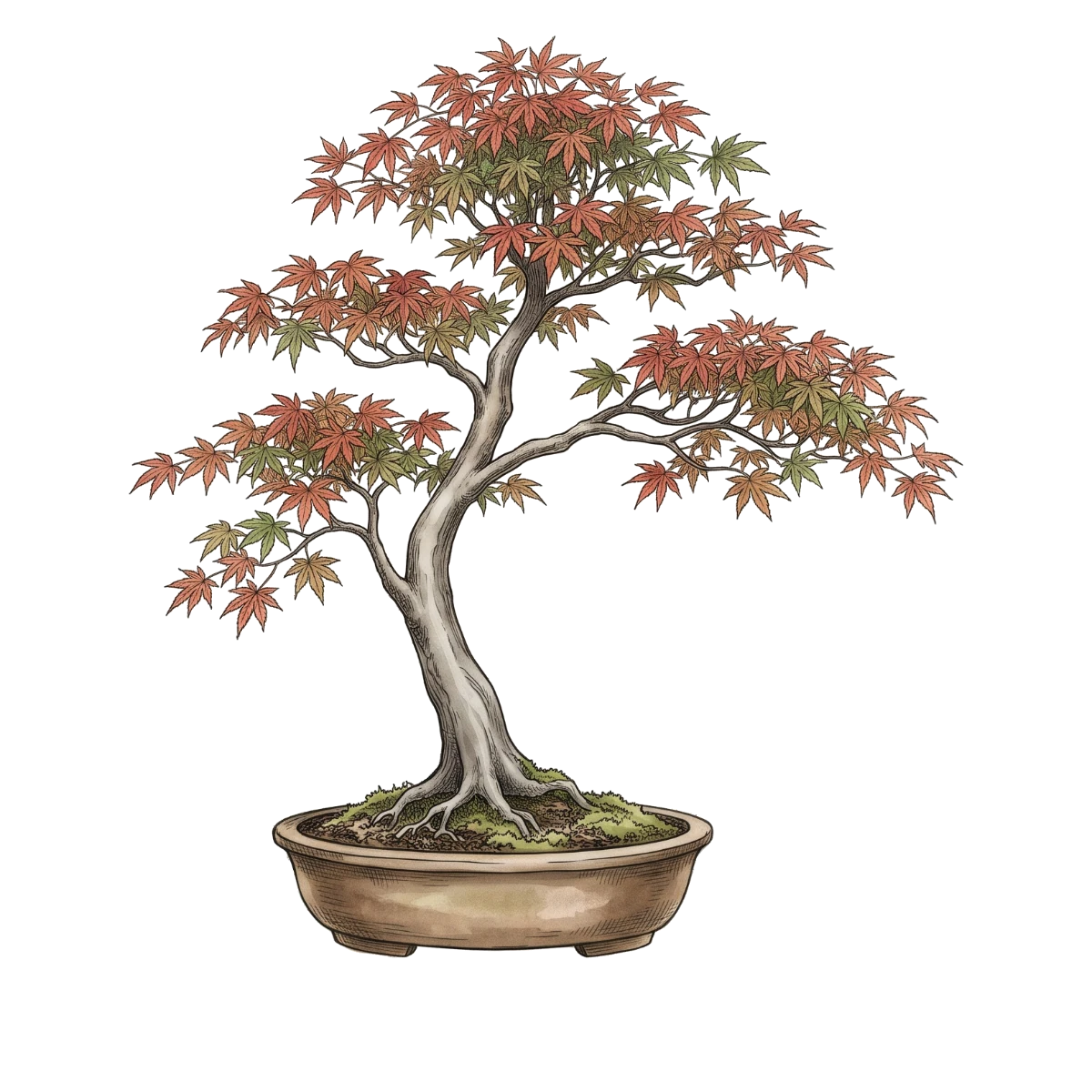
- Position
- Sun in spring; in summer, morning sun and afternoon shade.
More detail
In spring, while it is sprouting, it should get sun: the leaves come out smaller and the tree stronger. In the heat of a Mediterranean summer, however, it needs shade in the middle and the afternoon.
Varieties with fine or red leaves are the most sensitive: in strong sun or dry wind, the edges scorch. Protect it from wind too.
- Watering
- Never let the soil dry out completely. In summer, every day. How to water, step by step
More detail
It likes evenly moist soil, without waterlogging. It drinks a lot just before each flush and in summer; in hot weather it may need watering twice a day.
If it dries out completely even once, the leaves shrivel and scorch. In winter, without leaves, water much less, but don’t let the pot dry out completely.
- Feeding
- In spring and autumn, in moderation. None in winter.
More detail
Feed moderately once the leaves are out and again in autumn. Too much fertiliser gives big leaves and long shoots, exactly the opposite of what you want.
Don’t feed in winter or for four weeks after repotting.
- Soil
- Akadama, on its own or with 20 to 30 % pumice.
More detail
A soil that holds moisture without getting waterlogged: akadama on its own or with some pumice or volcanic grit.
It prefers neutral or slightly acidic soils; if your water is very hard, alternate with rainwater.
- Repotting
- Every 2 or 3 years, in late winter, when the buds swell.
More detail
The time is late winter, when the buds start to swell and before they open. A young tree may need it every two years; an established one, every three or four.
Trim no more than a third of the roots and afterwards protect it from strong sun and wind.
- Pruning
- Branches in autumn after leaf fall, or in midsummer.
More detail
Big cuts are made just after leaf fall, in autumn, or in high summer, when the tree is resting and heals quickly.
Avoid hard cuts in late winter and spring: maples bleed a lot of sap.
- Pinching
- In spring, let 2 or 3 pairs of leaves come out and cut the rest.
More detail
Its leaves grow in opposite pairs. When a new shoot opens its second or third pair, cut it back leaving one or two pairs.
On the strongest parts of the tree you can remove one leaf from each pair or trim the big leaves in May. Don’t strip all the leaves at once: the tree becomes unbalanced and loses twigs.
- Wiring
- Young branches, in spring or summer. The bark marks quickly.
More detail
Young branches bend well. Use thin aluminium wire, from spring to summer, and check it every few weeks.
Its bark is thin and marks very easily. Without leaves, in winter, the structure is easier to see, but the branches are stiffer.
- Cold
- Frost-hardy. In a pot, protect the roots below −10 °C.
More detail
It is a temperate-climate tree and needs winter cold to rest. Keep it outside.
In a pot, the roots are the most delicate part: protect them if temperatures will drop below about −10 °C or if it freezes hard for several days. Late frosts can scorch newly opened shoots.
Calendar
Based on a Mediterranean climate. In colder areas, put back the spring jobs.
Over the years
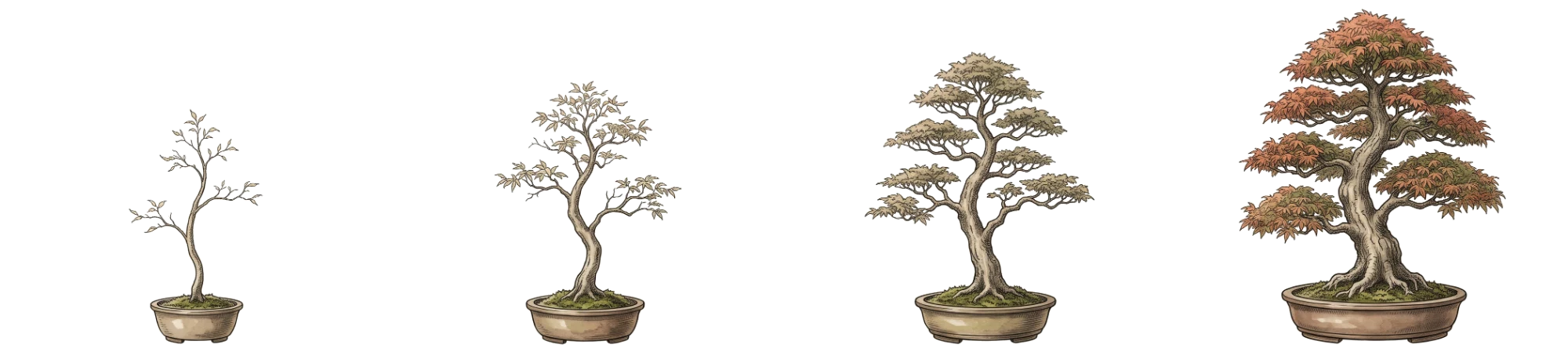
An approximate guide, assuming continued cultivation and pruning.
When you bring it home
- Unpack it today. Take the tree out of the box and remove any plastic or wrapping from the pot.
- Put it outside. Leave it in partial shade for 3 or 4 days, then move it to its permanent spot.
- Feel the soil before watering. If the top layer is still damp, wait.
- Put back any soil that has shifted. Spread it out without piling it against the trunk. It is normal for thick roots to show.
- Check it doesn’t wobble. If it moves in the pot, secure it so the roots can take hold.
- Leave it alone. For the first few weeks, don’t repot, prune or feed it.
If something looks wrong
Leaf scorch: brown, dry edges from strong sun, dry wind or lack of water. More shade and steady watering.
Aphids: colonies on the young shoots, with curled leaves and honeydew.
Scale insects: small bumps stuck to branches and trunk.
If in doubt, ask before treating.
With dogs and cats No reliable data
It isn’t on the ASPCA plant list, so there is no reliable information on whether it is toxic. To be safe, keep it where your dog or cat can’t chew it.
Source: ASPCA, toxic and non-toxic plants for dogs · ASPCA, toxic and non-toxic plants for cats. Checked on 17 November 2026.