
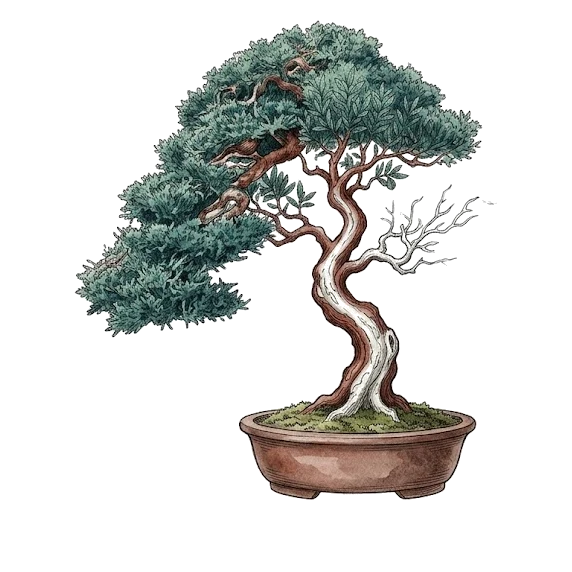
- Position
- Outdoors and in full sun all year round. Indoors it dies.
More detail
It is an outdoor tree in any climate. It needs direct sun to keep its foliage compact and green; in shade it stretches and weakens from the inside.
It copes well with Mediterranean heat and appreciates a little shade in the middle of the day in high summer. Indoors it doesn’t survive for long: it lacks light and a winter rest.
- Watering
- When the surface starts to dry out. Never waterlogged. How to water, step by step
More detail
Water thoroughly when the top layer is dry, until water runs out of the bottom. In summer it may need water every day; in winter, much less.
Constantly wet roots harm it more than a short drought. In summer you can mist the foliage in the evening to clean and cool it.
- Feeding
- In spring and autumn. Stop in high summer and in winter.
More detail
Feed while it is growing strongly: in spring and again in autumn once the heat drops. In high summer and in winter, it rests.
A tree in training can take more feed than an established one, which should get little so the foliage stays fine.
- Soil
- Very free-draining: akadama, pumice and volcanic grit.
More detail
It needs a soil that drains and aerates very well, because fine, wet soils rot its roots in winter. A common mix is equal parts akadama, pumice and volcanic grit.
Acidic mixes don’t suit it.
- Repotting
- Every 3 to 5 years, in spring, when the tips turn paler.
More detail
It doesn’t need frequent repotting. Do it in early spring, when the tips of the foliage start to turn a lighter green.
It is sensitive to losing a lot of root: trim carefully and afterwards keep it for a few weeks somewhere bright but out of strong sun.
- Pruning
- Branches in spring or autumn. In midwinter the cuts don’t heal.
More detail
Branch cuts and deadwood work are done in spring or early autumn, when the tree is active and heals.
In midwinter, with the tree dormant, wounds don’t close. Never cut a branch back so far that no green is left: junipers don’t regrow from bare wood.
- Pinching
- Don’t pinch it with your fingers: thin out long shoots with scissors.
More detail
For years, pinching the tips with your fingers was recommended, but many experts now advise against it: it weakens the tree and leaves brown tips.
It is better to let it grow and, in summer, thin it out with scissors, cutting the longest shoots and those growing downwards at their base, so light gets inside.
- Wiring
- Best from autumn to early spring. Make sure it doesn’t bite in.
More detail
Its branches are flexible and take strong bends, which is why it is the classic species for learning to wire. The best time is from autumn to early spring.
In spring and summer the branch thickens quickly: check the wire every few weeks so it doesn’t leave a mark.
- Cold
- Frost-hardy. If it freezes hard for several days, protect the pot.
More detail
It is very cold-hardy and needs to spend the winter outside to rest. Only in hard, long frosts is it worth protecting the pot: bury it in the ground or set it against a wall out of the wind.
Don’t bring it indoors in winter.
Calendar
Based on a Mediterranean climate. In colder areas, put back the spring jobs.
Over the years
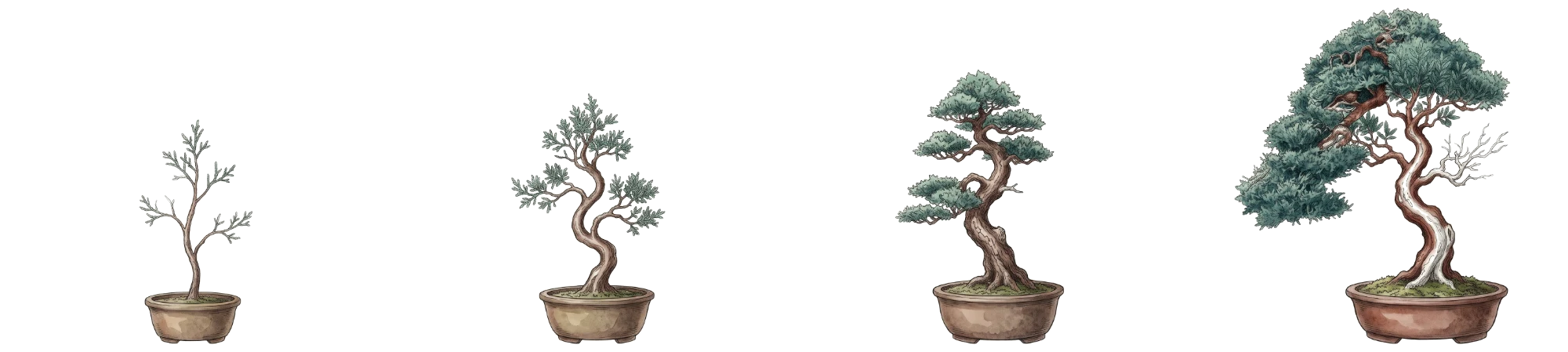
An approximate guide, assuming continued cultivation and pruning.
When you bring it home
- Unpack it today. Take the tree out of the box and remove any plastic or wrapping from the pot.
- Put it outside. Leave it in partial shade for 3 or 4 days, then move it to its permanent spot.
- Feel the soil before watering. If the top layer is still damp, wait.
- Put back any soil that has shifted. Spread it out without piling it against the trunk. It is normal for thick roots to show.
- Check it doesn’t wobble. If it moves in the pot, secure it so the roots can take hold.
- Leave it alone. For the first few weeks, don’t repot, prune or feed it.
If something looks wrong
Spider mites: dull foliage, pale speckling and fine webbing.
Rust: swellings on the branches that put out orange, jelly-like masses in a wet spring. Cut off the branch and don’t keep it near pear trees.
Overwatering: yellowing from the inside with soil that is always wet.
If in doubt, ask before treating.
With dogs and cats No reliable data
It isn’t on the ASPCA plant list, so there is no reliable information on whether it is toxic. To be safe, keep it where your dog or cat can’t chew it.
Source: ASPCA, toxic and non-toxic plants for dogs · ASPCA, toxic and non-toxic plants for cats. Checked on 17 November 2026.