
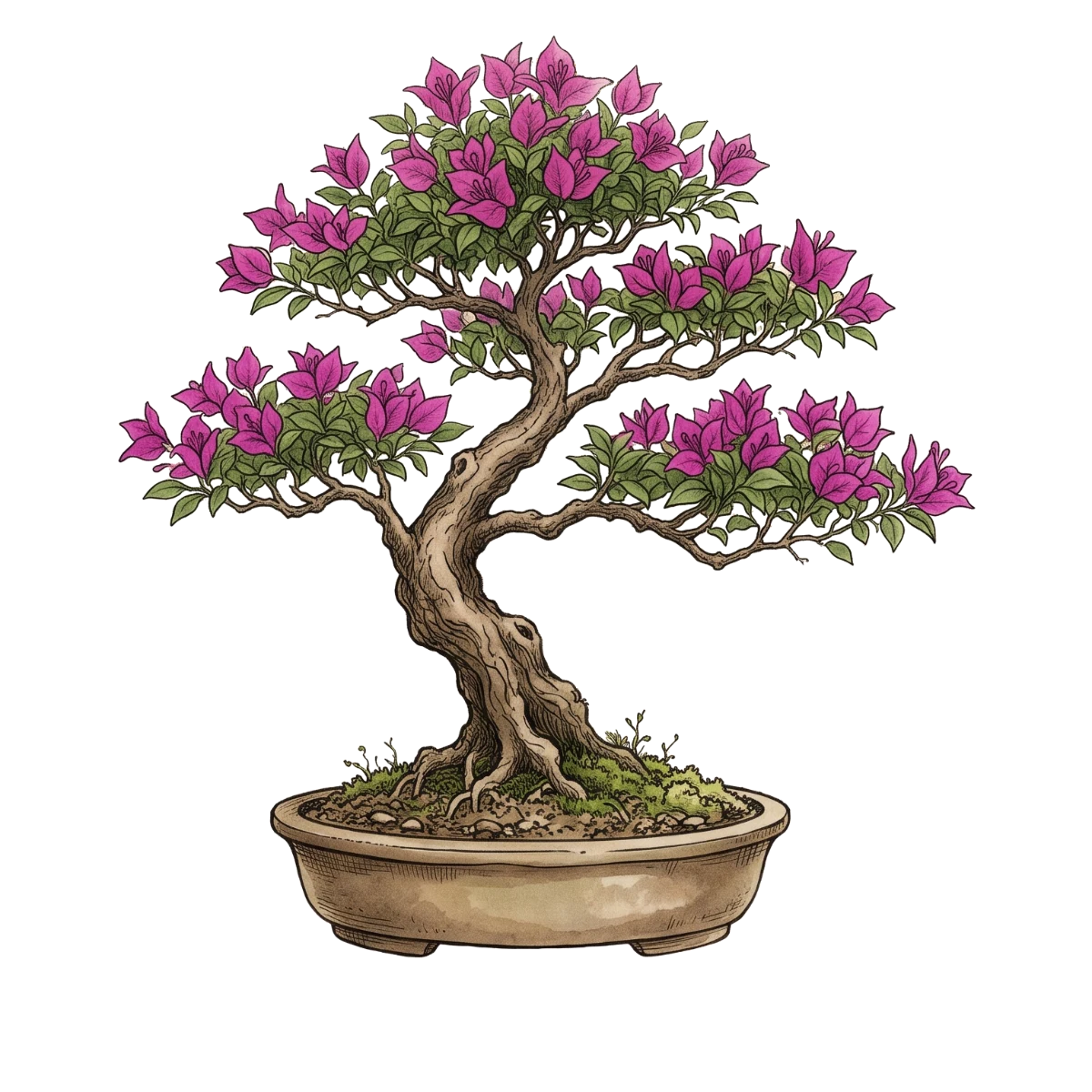
It comes from Brazil. Its colour isn’t in the flower: it comes from three modified leaves, thin as paper, pink or purple. The true flower is the small white tube in the centre.
At a glance
- Semi-evergreen
- Outdoors, sheltered in winter
- Full sun
- No frost
- Moderate care
- Main attraction: Flowers
- Position
- Outdoors and in full sun. Without sun it won’t flower.
More detail
It needs many hours of direct sun a day to flower: at least six.
In a Mediterranean climate, outdoors from spring until it turns cool; in winter, sheltered.
- Watering
- When the surface dries. Too much water costs it flowers. How to water, step by step
More detail
Water thoroughly when the top layer is dry. Too much water rots the roots and reduces flowering.
In winter, in the cold, very little water.
- Feeding
- Little nitrogen: it flowers better when a little «hungry».
More detail
Feed every two or three weeks from spring to the end of summer with a fertiliser low in nitrogen and rich in potassium.
With lots of nitrogen it produces leaves and few bracts.
- Soil
- A free-draining bonsai mix.
More detail
A free-draining bonsai soil, with akadama and volcanic grit or pumice.
- Repotting
- Every 2 to 4 years, once spring is warm. Very fragile roots.
More detail
Repot in spring, once the warm weather has settled. Its roots are fine, yellow and break easily: untangle them carefully and don’t leave them exposed to the air.
A little pot-bound, it flowers better.
- Pruning
- Hard pruning in late winter. Touch-ups after each flowering.
More detail
It flowers on new wood: hard pruning in late winter or early spring, before it sprouts.
After each round of flowers, cut long shoots back leaving two leaves. Wear gloves: it has thorns.
- Pinching
- After flowering, leave 2 leaves per shoot. In summer, little.
More detail
After each flowering, shorten the shoots to two leaves. If you trim a lot in summer, you remove the flowers.
Remove dry bracts so it flowers again.
- Wiring
- Young branches only. Old wood is brittle.
More detail
Young branches can be guided with wire; old ones are hard and snap. Mind the thorns.
Almost all the shape is achieved by pruning.
- Cold
- It can’t take frost. Below 5 °C, keep it sheltered and in the light.
More detail
It is subtropical: frost makes it drop its leaves and it can die. In winter, 10 to 15 °C is ideal; shelter it below 5 °C in a bright place.
Water very little while it is cold.
Calendar
Based on a Mediterranean climate. In winter, sheltered from frost.
When you bring it home
- Unpack it today. Take the tree out of the box and remove any plastic or wrapping from the pot.
- Put it outside. Leave it in partial shade for 3 or 4 days, then move it to its permanent spot.
- Feel the soil before watering. If the top layer is still damp, wait.
- Put back any soil that has shifted. Spread it out without piling it against the trunk. It is normal for thick roots to show.
- Check it doesn’t wobble. If it moves in the pot, secure it so the roots can take hold.
- Leave it alone. For the first few weeks, don’t repot, prune or feed it.
If something looks wrong
No flowers: from lack of sun, too much water or too much nitrogen.
Aphids: colonies on the tender shoots, with honeydew.
Scale insects: small bumps or cottony tufts on stems and leaf undersides.
If in doubt, ask before treating.
With dogs and cats No reliable data
It isn’t on the ASPCA plant list, so there is no reliable information on whether it is toxic. To be safe, keep it where your dog or cat can’t chew it.
Source: ASPCA, toxic and non-toxic plants for dogs · ASPCA, toxic and non-toxic plants for cats. Checked on 17 November 2026.