
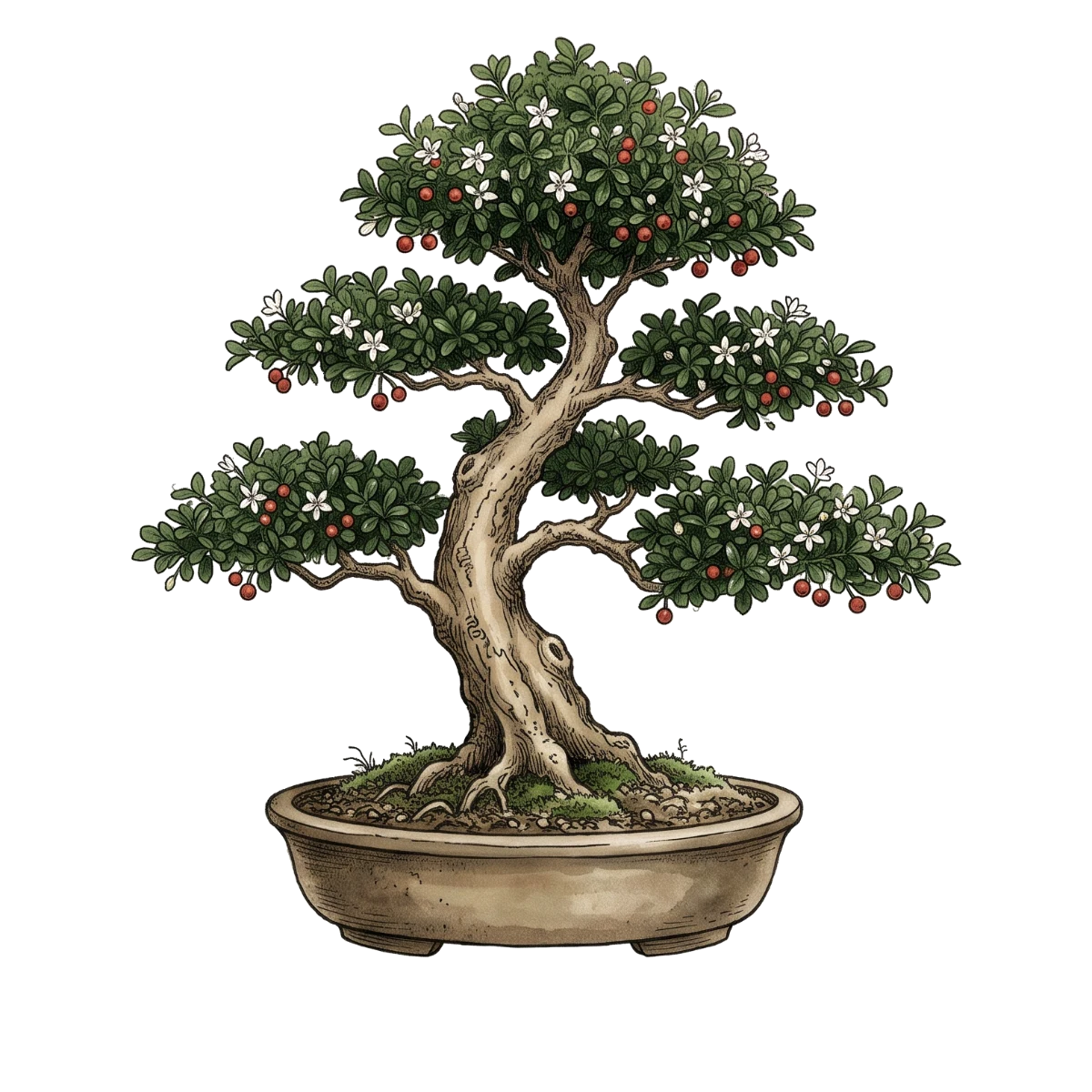
It takes its name from the Chinese province of Fujian (Fukien). In China it is highly prized for penjing, the art from which bonsai was born. Its white flowers give way to small fruits that turn from green to red and almost black.
At a glance
- Evergreen
- Bright indoor spot
- Plenty of light, by a window
- No frost
- Moderate care
- Main attraction: FlowersFruit
- Position
- Indoors, by the brightest window. In summer, outside in a sheltered spot.
More detail
It is tropical and in Spain it does best indoors in winter, next to a very bright window and away from radiators.
In summer it can go out to a sheltered corner with morning sun. Do it gradually: it dislikes sudden changes in light or temperature.
- Watering
- Don’t let it dry out completely or sit waterlogged. How to water, step by step
More detail
It is sensitive to both extremes: if it dries out, it drops leaves; if it is waterlogged, the roots rot. Water as soon as the surface starts to dry.
It appreciates humidity: a tray of gravel and water under the pot helps indoors.
- Feeding
- From spring to autumn, preferably solid organic fertiliser.
More detail
Its roots are delicate, so solid organic fertiliser is recommended. If you use liquid feed, stick to the stated dose and always apply it to moist soil.
In winter, if it is indoors and still growing, one dose a month.
- Soil
- It should drain yet hold some water: akadama with a little pumice.
More detail
It needs a soil that drains well but doesn’t dry out too fast: akadama with some pumice and a small organic part.
Compacted soil is the most common cause of rot.
- Repotting
- Every 2 or 3 years, in spring, trimming little root.
More detail
Repot it in spring, as the warm weather begins. Its roots are sensitive: trim little and carefully.
Afterwards, a few weeks in partial shade and no feeding.
- Pruning
- Hard pruning in late winter. Touch-ups all year round.
More detail
Structural pruning is done in late winter or early spring. Shaping touch-ups, at any time during the season.
It regrows well from old wood.
- Pinching
- When a shoot has 6 to 8 leaves, cut it back leaving 2.
More detail
Let the shoot grow 6 or 8 leaves and cut it back leaving the first two.
If you want flowers and fruit, leave some tips untrimmed: it flowers on new shoots almost all year.
- Wiring
- Young branches, carefully: the bark marks.
More detail
Young branches can be wired at any time of year; old ones are stiff.
Check the wire often so it doesn’t bite in. Much of the shape is achieved by pruning alone.
- Cold
- It can’t take frost. Best not below 10 °C.
More detail
It is tropical: it is happiest between 15 and 22 °C and tolerates occasional drops, but not frost.
Bring it indoors before nights fall below 10 °C and avoid sudden temperature changes.
Calendar
Based on growing indoors, with summers outside in a Mediterranean climate.
Over the years
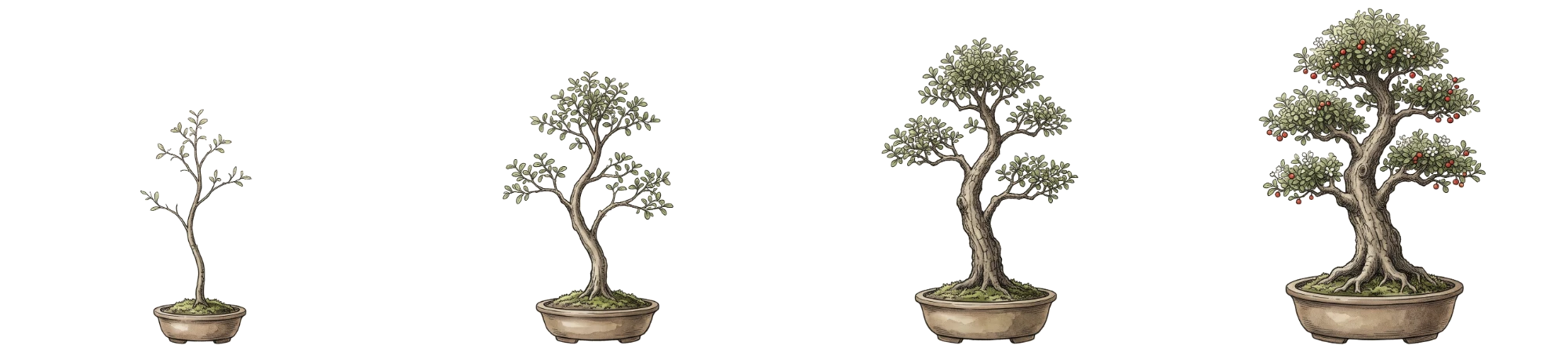
An approximate guide, assuming continued cultivation and pruning.
When you bring it home
- Unpack it today. Take the tree out of the box and remove any plastic or wrapping from the pot.
- Find it a spot. Give it plenty of light, away from heaters and draughts.
- Feel the soil before watering. If the top layer is still damp, wait.
- Put back any soil that has shifted. Spread it out without piling it against the trunk. It is normal for thick roots to show.
- Check it doesn’t wobble. If it moves in the pot, secure it so the roots can take hold.
- Leave it alone. For the first few weeks, don’t repot, prune or feed it.
If something looks wrong
Spider mites: pale speckling and webbing. Its most common pest; careful: it is sensitive to many insecticides.
Root rot: falling leaves and soil that is always wet. Improve drainage.
Leaf drop: caused by sudden changes in light, temperature or watering.
If in doubt, ask before treating.
With dogs and cats No reliable data
It isn’t on the ASPCA plant list, so there is no reliable information on whether it is toxic. To be safe, keep it where your dog or cat can’t chew it.
Source: ASPCA, toxic and non-toxic plants for dogs · ASPCA, toxic and non-toxic plants for cats. Checked on 17 November 2026.