
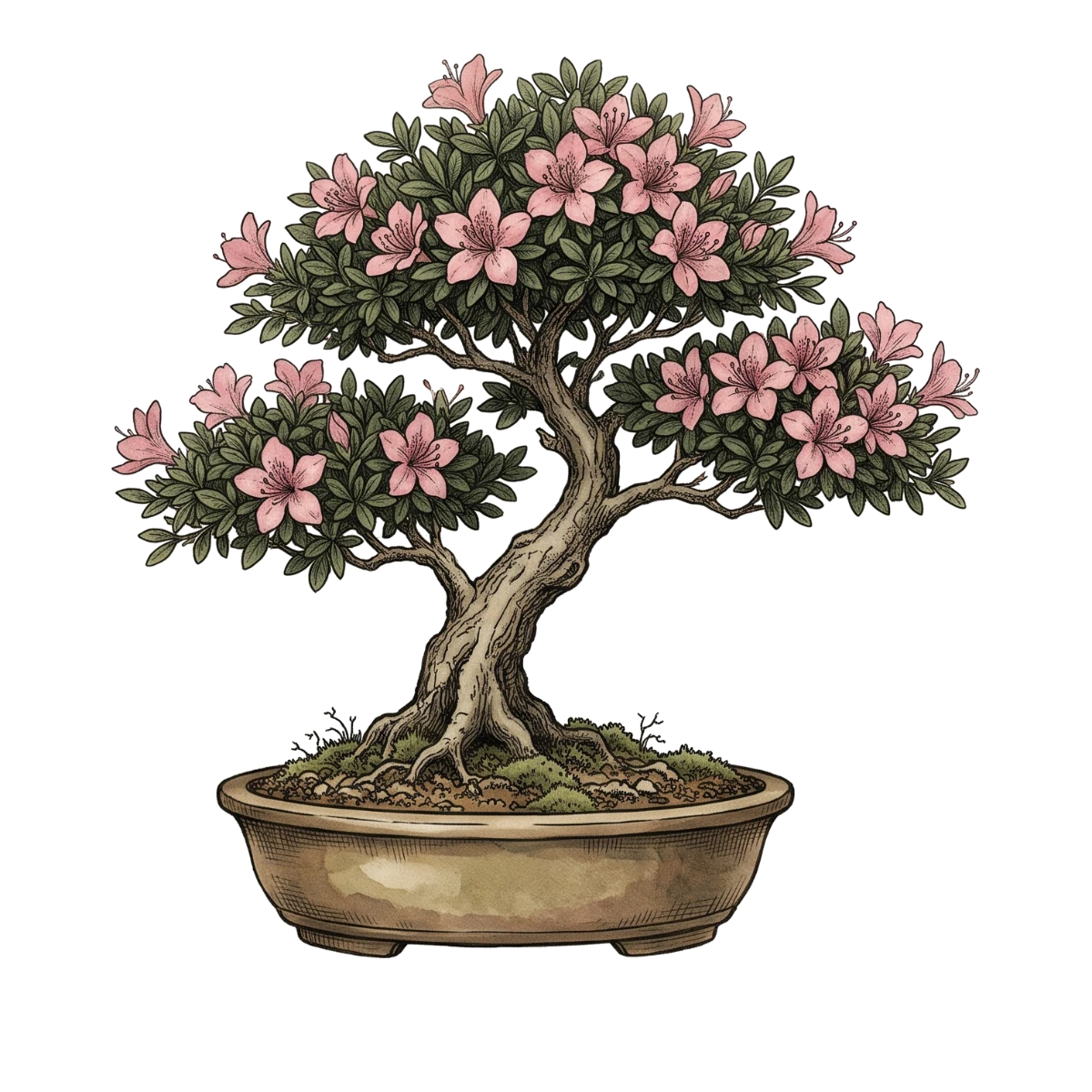
It is the satsuki azalea, named after the fifth month of the old Japanese calendar, when it flowers. There are flowers of almost every colour, with stripes and flecks, and a single tree can bear different flowers.
At a glance
- Evergreen
- Outdoors, sheltered in winter
- Sun, with shade at the height of summer
- Only short, mild frosts
- Moderate care
- Main attraction: Flowers
- Position
- Outdoors, with morning sun and shade in the hottest hours.
More detail
It lives outdoors all year round. It appreciates morning sun and shade in the middle of the day in a Mediterranean summer.
While it is flowering, protect it from rain and strong sun: the flowers spoil quickly if they get wet.
- Watering
- Never let it dry out, and use lime-free water: rainwater or filtered. How to water, step by step
More detail
Its roots are very fine and dry out easily, which can be fatal. Keep the root ball always moist, without waterlogging.
Use rainwater or filtered water: lime turns its leaves yellow. During flowering, water the soil without wetting the flowers.
- Feeding
- Ericaceous fertiliser, before and after flowering. None while in flower.
More detail
Use a fertiliser for azaleas or acid-loving plants. Stop while it is flowering, because it would favour the leaves at the expense of the flowers.
After flowering, and a few weeks after repotting, start feeding again until late summer.
- Soil
- Acidic and lime-free: kanuma, on its own or with a little akadama.
More detail
Kanuma, a soft, acidic Japanese volcanic soil, is the ideal medium for its fine roots. It can be used on its own or with a little akadama and pumice.
Never use soils containing lime.
- Repotting
- Every 2 or 3 years, right after flowering.
More detail
The best time is just as flowering ends, before the new shoots harden.
Young trees can be repotted every year; established ones, every two or three.
- Pruning
- Right after flowering. If you leave it later, you’ll lose flowers.
More detail
When flowering ends, remove the spent flowers and prune. Next year’s buds form in summer at the tips of the shoots, so if you prune late, you remove the flowers.
It responds well to pruning and sprouts from old wood.
- Pinching
- After flowering, leave 2 shoots per tip, with 2 leaves each.
More detail
After flowering, several shoots grow from each tip. Keep two and cut them back to two leaves: that way it branches without losing next year’s flowers.
Also remove spent flowers so it doesn’t set seed, which weakens it.
- Wiring
- Gently: the wood is brittle. Best after flowering.
More detail
Its branches snap easily. Wire carefully, on young branches, after flowering or in autumn.
On well-established trees, better not to force it.
- Cold
- It withstands mild frosts. Protect it below −5 °C.
More detail
It withstands moderate cold and lives outside in winter. Protect the pot if it freezes hard or for several days, because its shallow roots are delicate.
Don’t bring it indoors: it needs winter to form flower buds.
Calendar
Based on a Mediterranean climate. All jobs, after flowering.
Over the years
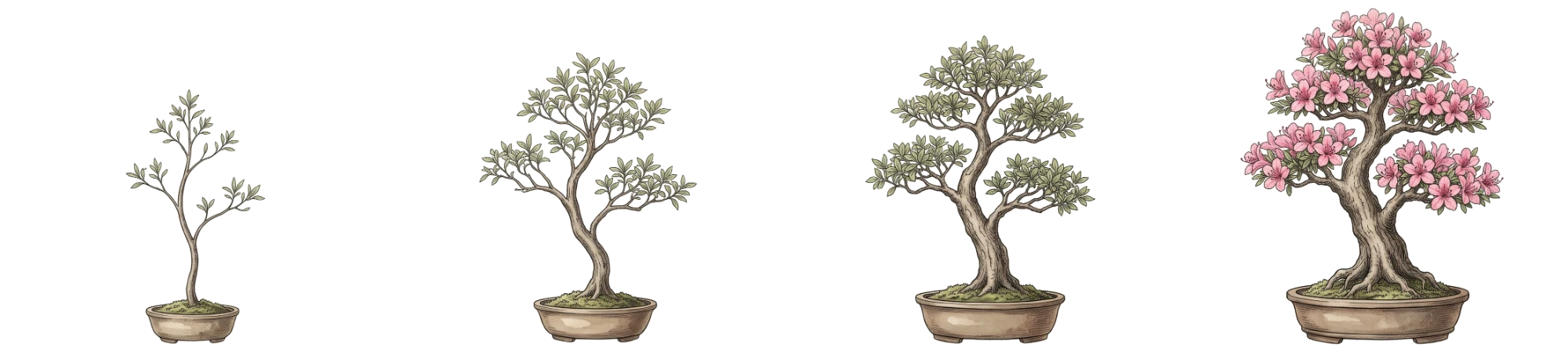
An approximate guide, assuming continued cultivation and pruning.
When you bring it home
- Unpack it today. Take the tree out of the box and remove any plastic or wrapping from the pot.
- Put it outside. Leave it in partial shade for 3 or 4 days, then move it to its permanent spot.
- Feel the soil before watering. If the top layer is still damp, wait.
- Put back any soil that has shifted. Spread it out without piling it against the trunk. It is normal for thick roots to show.
- Check it doesn’t wobble. If it moves in the pot, secure it so the roots can take hold.
- Leave it alone. For the first few weeks, don’t repot, prune or feed it.
If something looks wrong
Chlorosis: yellow leaves with green veins, from lime in the water or the soil.
Spider mites: dull, speckled leaves in dry air.
Leaf gall: thickened, pale leaves and shoots. Remove them early.
If in doubt, ask before treating.
With dogs and cats Highly toxic
Highly toxic to dogs and cats: a few leaves can cause vomiting, drooling, weakness and serious heart problems. If it has chewed it, go to the vet without waiting.
Source: ASPCA, rhododendron and azalea (Rhododendron spp.). Checked on 17 November 2026.