
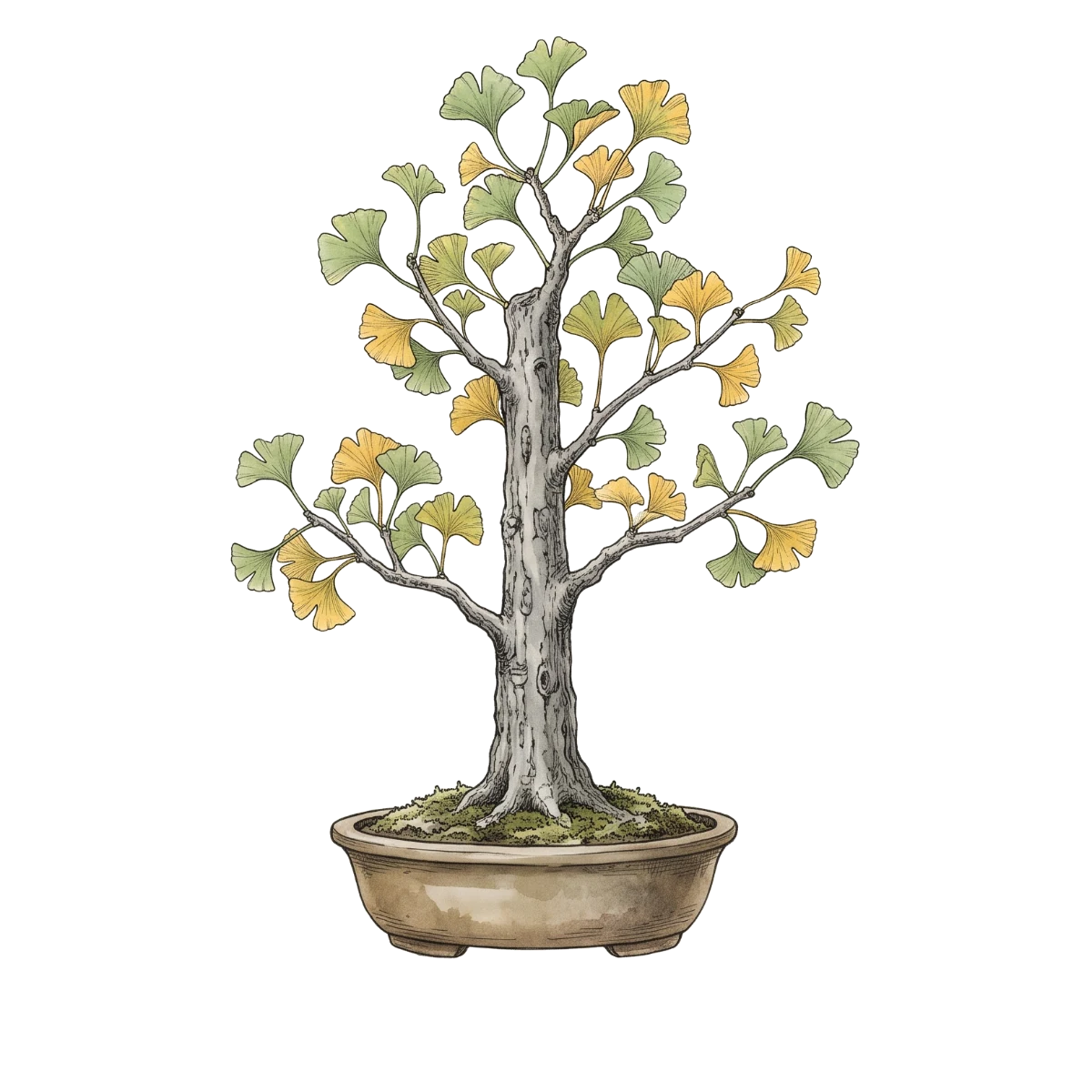
It is a living fossil: the last of a group of trees that already existed more than 200 million years ago. Several ginkgos survived the Hiroshima bomb about 2 km from the centre of the blast.
At a glance
- Deciduous
- Outdoors all year round
- Full sun
- Frost-hardy; protect the pot
- Moderate care
- Main attraction: Autumn colour
- Position
- Outdoors and in the sun. Young trees, better in partial shade.
More detail
It likes sun, though young trees appreciate partial shade. It lives outdoors all year round.
In a Mediterranean summer, a little afternoon shade stops the leaves scorching.
- Watering
- When the surface dries. No waterlogging. How to water, step by step
More detail
Water thoroughly when the top layer is dry. It doesn’t like waterlogging.
In winter, without leaves, very little water.
- Feeding
- From spring to the end of summer, in moderation.
More detail
Feed moderately while it is growing. It grows slowly and there is no need to push it.
None in winter.
- Soil
- A free-draining bonsai mix. It tolerates lime.
More detail
Any free-draining bonsai mix. It tolerates both acidic and chalky soils.
For young trees, which thicken their roots quickly, a medium grain is best.
- Repotting
- Young, every year; established, every 2 to 5. In spring.
More detail
Young trees thicken their roots fast and may need repotting every year; established ones, every two to five.
In spring, without cutting back much root.
- Pruning
- Very carefully: its cuts don’t heal well.
More detail
Pruning wounds on a ginkgo hardly close and leave scars. Cut only what is necessary and think each cut through.
Cuts are best made in spring.
- Pinching
- Shorten long shoots so it thickens and branches.
More detail
Trimming new shoots helps thicken the trunk and keep the shape. Respect its natural, rather columnar form.
Removing leaves doesn’t make them smaller.
- Wiring
- Sparingly and with thin wire: the bark marks.
More detail
It can be wired from spring to autumn, but its bark is soft and the marks don’t fade.
Use thin wire and check it often. Pruning is almost always enough.
- Cold
- The tree is frost-hardy; in a pot, protect the roots.
More detail
In the ground it withstands hard frosts, but its roots in a pot are sensitive to freezing. Protect them if it freezes hard: mulch, a sheltered corner or a cold greenhouse.
Don’t bring it indoors.
Calendar
Based on a Mediterranean climate. In colder areas, put back the spring jobs.
Over the years
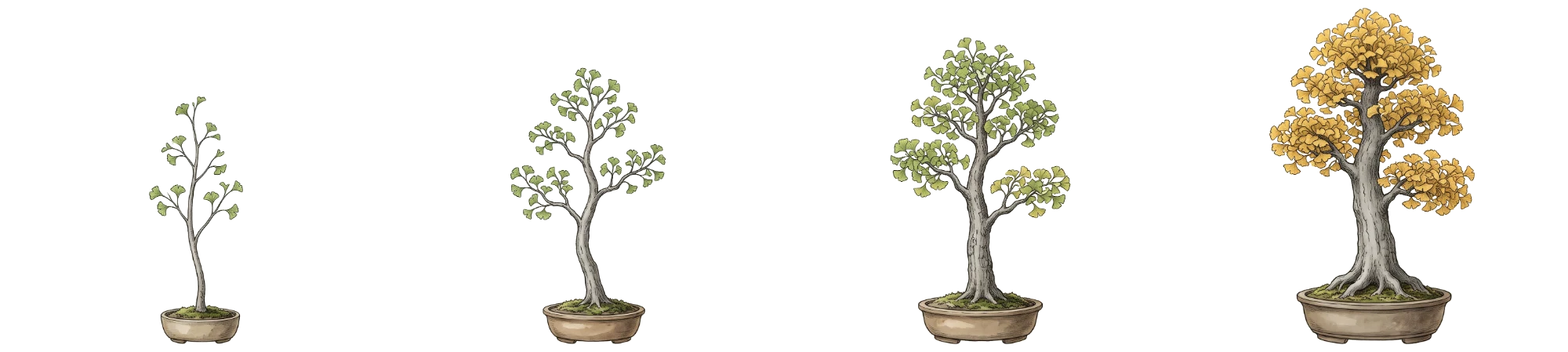
An approximate guide, assuming continued cultivation and pruning.
When you bring it home
- Unpack it today. Take the tree out of the box and remove any plastic or wrapping from the pot.
- Put it outside. Leave it in partial shade for 3 or 4 days, then move it to its permanent spot.
- Feel the soil before watering. If the top layer is still damp, wait.
- Put back any soil that has shifted. Spread it out without piling it against the trunk. It is normal for thick roots to show.
- Check it doesn’t wobble. If it moves in the pot, secure it so the roots can take hold.
- Leave it alone. For the first few weeks, don’t repot, prune or feed it.
If something looks wrong
Leaf scorch: dry edges from strong afternoon sun in summer.
Overwatering: yellow leaves out of season with wet soil.
Branch dieback: after large cuts, which don’t heal well. Cut little.
If in doubt, ask before treating.
With dogs and cats No reliable data
It isn’t on the ASPCA plant list, so there is no reliable information on whether it is toxic. To be safe, keep it where your dog or cat can’t chew it.
Source: ASPCA, toxic and non-toxic plants for dogs · ASPCA, toxic and non-toxic plants for cats. Checked on 17 November 2026.