
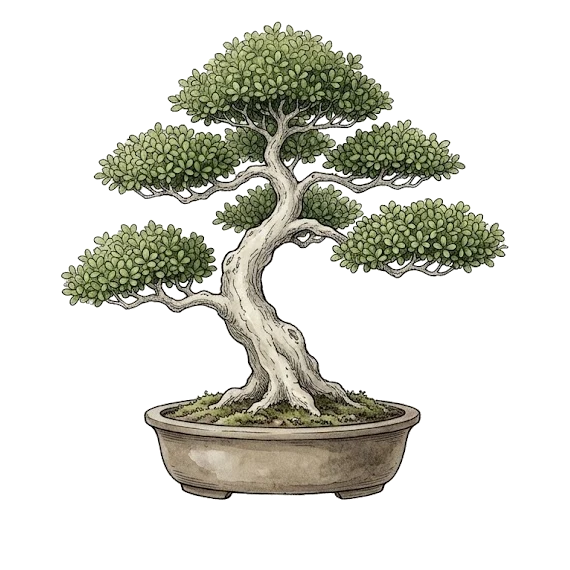
- Position
- Outdoors, in sun or partial shade. In midsummer, better without afternoon sun.
More detail
It lives outdoors all year round. It copes well with partial shade and, in a Mediterranean summer, it is grateful not to get the strong afternoon sun, which can scorch the leaves.
It doesn’t thrive indoors.
- Watering
- When the surface starts to dry out. Don’t leave it waterlogged. How to water, step by step
More detail
Water thoroughly when the top layer dries out. It grows slowly and doesn’t use as much water as other species, so be careful not to overdo it.
Water the soil, not the foliage, especially in warm, humid weather: that reduces the risk of fungal disease.
- Feeding
- In spring and autumn, in moderation.
More detail
Feed in spring and autumn at a moderate dose. Too much fertiliser, especially nitrogen, gives large leaves and soft shoots.
Don’t feed after repotting or in high summer.
- Soil
- A free-draining bonsai mix: akadama with some volcanic grit.
More detail
A bonsai mix that drains and lets air in, with akadama and some volcanic grit or pumice.
It tolerates lime well: it is a species of limestone soils.
- Repotting
- Every 2 or 3 years. In spring or, better still, in early summer.
More detail
It responds well to repotting every two or three years. Many growers prefer to do it in early summer, when the roots are active, rather than in early spring.
An established box can stay a little pot-bound: it grows more slowly and keeps its leaves small.
- Pruning
- Let it grow in spring and trim to shape from midsummer.
More detail
At the start of the season, let it grow freely so it gains strength. Then, from midsummer to autumn, trim to keep the outline.
Thin out the inside so light and air can get in: a box that is too dense is more prone to fungal disease.
- Pinching
- When a shoot has 4 to 6 pairs of leaves, cut it back to 1 or 2.
More detail
Its leaves grow in opposite pairs. When a new shoot has 4 to 6 pairs, cut it back leaving one or two.
Repeat with each flush of shoots from midsummer onwards.
- Wiring
- Carefully: the bark is thin and marks easily. Best on young branches.
More detail
The branches can be wired, but the bark is thin and easily damaged. Protect the branch or use thin wire, and don’t leave it on for long.
On established trees, pruning is usually enough to keep the shape.
- Cold
- Very frost-hardy. In a pot, protect the roots in hard frosts.
More detail
It is very cold-hardy. Only in hard, long frosts is it worth protecting the pot from wind and ice.
Don’t bring it indoors in winter.
Calendar
Based on a Mediterranean climate. In colder areas, put back the spring jobs.
Over the years
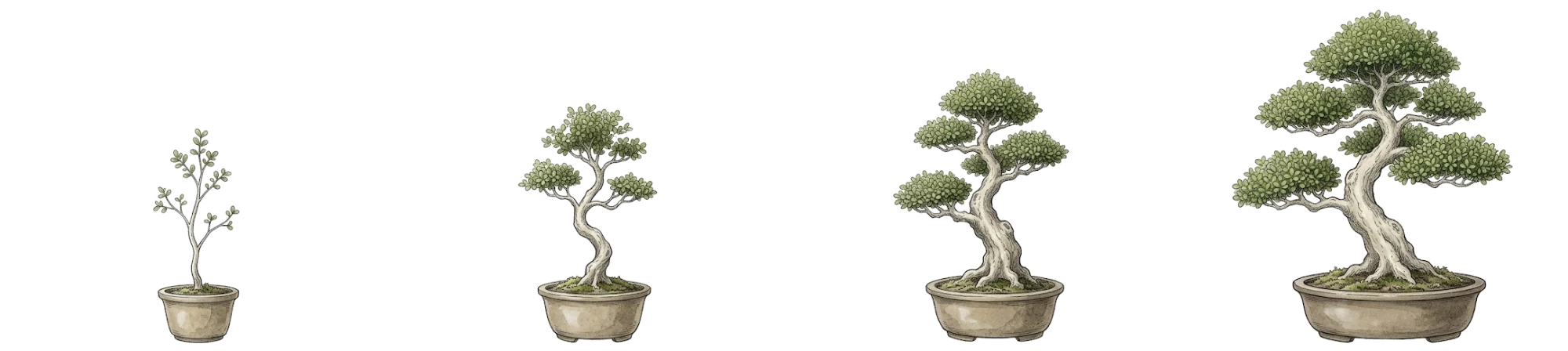
An approximate guide, assuming continued cultivation and pruning.
When you bring it home
- Unpack it today. Take the tree out of the box and remove any plastic or wrapping from the pot.
- Put it outside. Leave it in partial shade for 3 or 4 days, then move it to its permanent spot.
- Feel the soil before watering. If the top layer is still damp, wait.
- Put back any soil that has shifted. Spread it out without piling it against the trunk. It is normal for thick roots to show.
- Check it doesn’t wobble. If it moves in the pot, secure it so the roots can take hold.
- Leave it alone. For the first few weeks, don’t repot, prune or feed it.
If something looks wrong
Box tree moth: green caterpillars with black stripes that eat the leaves and leave webbing and droppings. Check the inside of the tree in spring.
Box blight: brown spots, falling leaves and bare branches in hot, humid weather. Remove the affected parts and improve airflow.
Overwatering: leaves turning yellow or bronze while the soil is wet.
If in doubt, ask before treating.
With dogs and cats Toxic
The ASPCA lists it as toxic to dogs and cats. Keep it out of their reach and, if they chew it, call your vet.
Source: ASPCA, toxic and non-toxic plants for dogs · ASPCA, toxic and non-toxic plants for cats. Checked on 17 November 2026.