
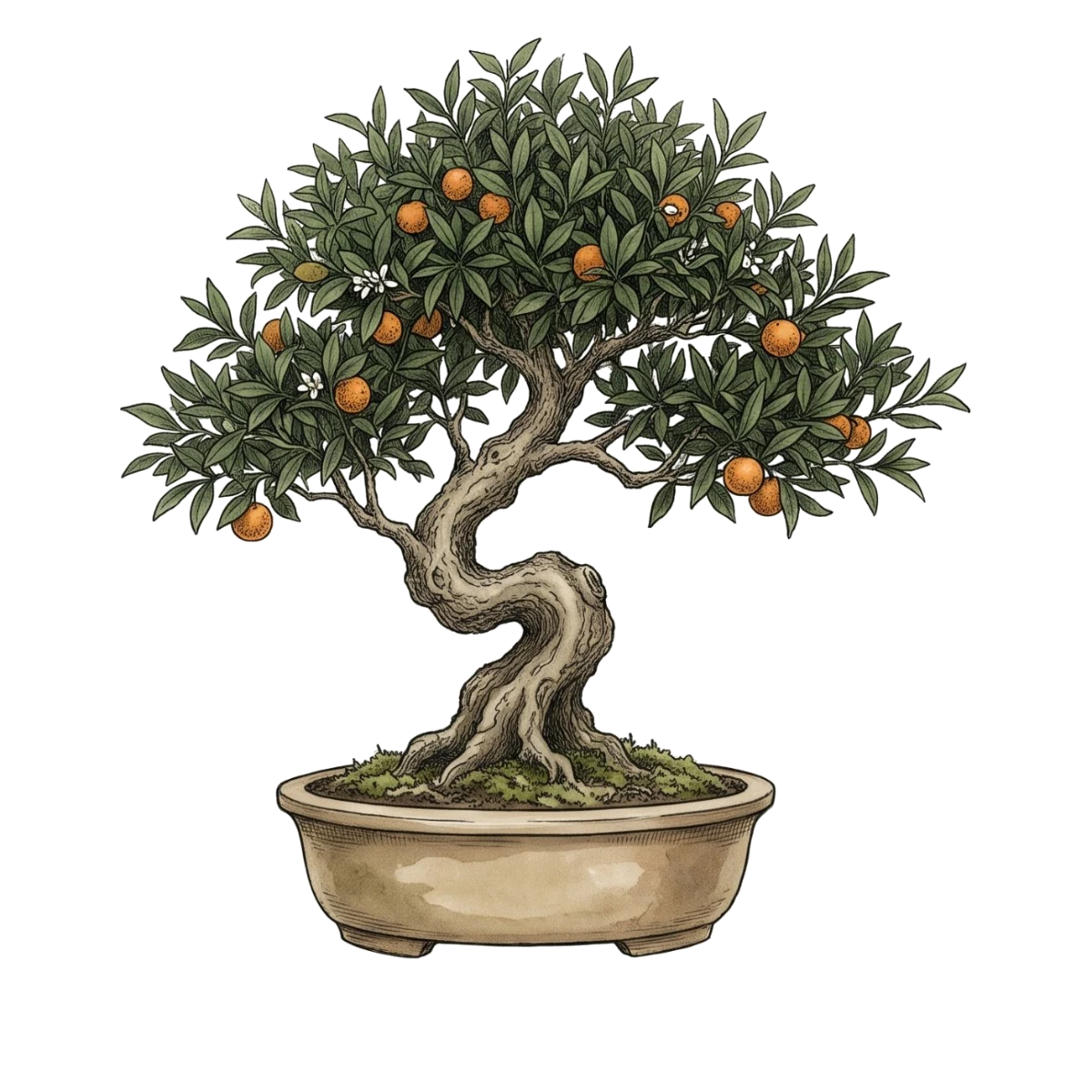
- Position
- Outdoors, in the sun and out of the wind. With less than 2 or 3 hours of direct sun it flowers poorly.
More detail
It is a Mediterranean citrus: in a mild climate it lives outdoors all year round. It needs direct sun, at least a few hours each day, to flower and set fruit, and it appreciates a corner sheltered from strong wind.
Turn the pot from time to time so the canopy grows evenly. If winters are harsh where you live, move it for the cold months to a bright, unheated space.
- Watering
- When the top layer starts to dry out, until water runs out of the bottom. Empty the saucer. How to water, step by step
More detail
Water from above with a fine-rose watering can until water runs out of the drainage holes. Let the surface dry a little between waterings: feeling the soil is the best guide.
Don’t leave water in the saucer, because the roots rot easily. If your water is very hard, alternate with rainwater: lime ends up turning the leaves yellow.
- Feeding
- From February to October, with citrus fertiliser.
More detail
Citrus trees need food for almost the whole growing year, from late winter well into autumn. A balanced citrus fertiliser with iron and trace elements helps keep the leaves dark green.
Don’t feed a freshly repotted or weakened tree: wait until it is sprouting strongly again.
- Soil
- A free-draining mix for broadleaf bonsai.
More detail
A mix for broadleaf bonsai works, with akadama and some volcanic grit or pumice so water doesn’t sit.
Avoid heavy garden soil and mixes that compact: in a small pot they suffocate the roots within a few months.
- Repotting
- Every 2 or 3 years, in February or March, before it sprouts. Thin the canopy a little when you do.
More detail
Young trees grow fast and may need repotting every 1 or 2 years; established ones, every 2 or 3.
Do it in late winter, before new growth. If you trim the roots, remove some of the leaves too so the tree doesn’t lose more water than it can take up, and keep it in partial shade for a few weeks.
- Pruning
- Structural pruning in late winter. In summer, just tidying.
More detail
Big cuts, to remove branches or shorten long ones, are made in late winter, before growth starts.
During the season it is enough to trim the shoots that stray from the outline. Bear in mind that the flowers grow on the current year’s wood: if you prune hard in spring, it will flower less.
- Pinching
- Let the shoot grow 6 to 8 leaves and cut it back to the first 2.
More detail
When a new shoot lengthens, wait until it has 6 to 8 leaves and cut it back leaving the first two. That way it branches and the canopy gets denser.
From spring to the end of summer you can repeat this with each flush of shoots. Leave the ones carrying flower buds if you want flowers and fruit.
- Wiring
- All year round. In spring it thickens fast: keep an eye on the wire.
More detail
Young branches are flexible and wire well at any time of year. Use aluminium wire and don’t wind it tight.
Check it every few weeks, especially in spring and early summer, when the branch thickens and the wire can mark the bark.
- Cold
- It withstands short, mild frosts. Below about −3 °C, shelter it somewhere unheated.
More detail
It is one of the bitter oranges that tolerate cold best, but in a pot the roots are very exposed. Protect it from hard frosts or several days in a row below zero.
The best shelter is somewhere cool and bright: an enclosed porch, a conservatory or a cold greenhouse. In a heated room it drops leaves and fills up with pests.
Calendar
Based on a Mediterranean climate. In colder areas, put back the spring jobs.
When you bring it home
- Unpack it today. Take the tree out of the box and remove any plastic or wrapping from the pot.
- Put it outside. Leave it in partial shade for 3 or 4 days, then move it into full sun.
- Feel the soil before watering. If the top layer is still damp, wait.
- Put back any soil that has shifted. Spread it out without piling it against the trunk. It is normal for thick roots to show.
- Check it doesn’t wobble. If it moves in the pot, secure it so the roots can take hold.
- Leave it alone. For the first few weeks, don’t repot, prune or feed it.
If something looks wrong
Leaf miner: silvery trails in young leaves, which curl up. Remove badly damaged ones.
Aphids and scale: colonies on the shoots or small bumps on leaves and branches, with sticky honeydew and sooty mould. Clean them off early.
Chlorosis: yellow leaves with green veins: iron deficiency caused by lime.
If in doubt, ask before treating.
With dogs and cats Toxic
The ASPCA lists it as toxic to dogs and cats. Keep it out of their reach and, if they chew it, call your vet.
Source: ASPCA, toxic and non-toxic plants for dogs · ASPCA, toxic and non-toxic plants for cats. Checked on 17 November 2026.