
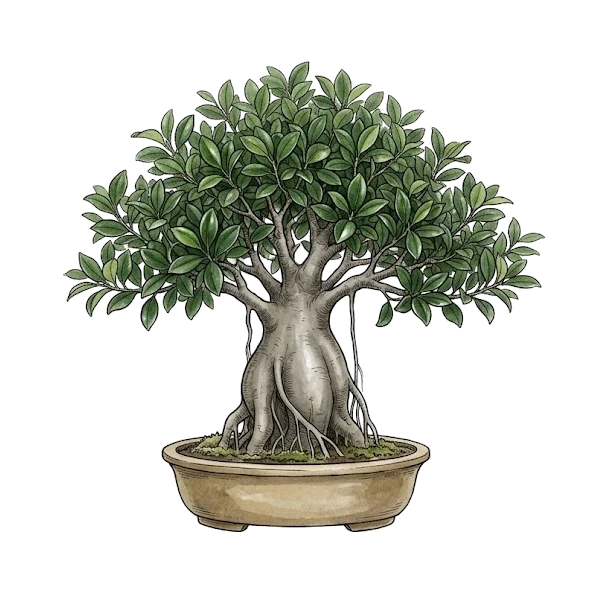
- Position
- Indoors, by the brightest window. In summer, outdoors if nights stay above 12 °C.
More detail
It needs all the light you can give it: next to a south- or west-facing window, without heavy curtains. Once used to it, it copes well with direct sun.
As soon as nights stay above 12 or 15 °C it can go out on a balcony or terrace, where it grows much more. Do it gradually, starting in partial shade, so the leaves don’t scorch. In coastal areas with very mild winters it can live outdoors all year round, in a sheltered spot.
- Watering
- When the surface feels dry. Better a little dry than waterlogged. How to water, step by step
More detail
Water thoroughly when the top layer dries out and let it drain well. In summer, outdoors, it may need water every day; indoors in winter, much less.
Almost all leaf drop in ficus is due to overwatering or sudden changes of position. Avoid very cold water, which also makes it shed leaves.
- Feeding
- From spring to autumn, every 2 weeks. In winter, little or none.
More detail
It is a fast-growing species and benefits from regular feeding while it is active: every two weeks from spring to autumn, with a balanced fertiliser.
In winter, if it stops growing, stop feeding. If it is indoors and still putting out shoots, one dose a month is enough.
- Soil
- Akadama, on its own or with some volcanic grit. It mustn’t compact.
More detail
Many ficus arrive in compact soil that holds too much water. It is worth replacing it at the first repotting with an airy mix: akadama on its own or with 20 to 30 % volcanic grit or pumice.
With a soil like this the roots can breathe and it is harder to overwater.
- Repotting
- Every 2 years, in May or June, once the warm weather has settled.
More detail
Ficus root quickly in warm weather. The best time is from late spring to early summer, when nights are already mild.
You can cut the roots back firmly if the tree is healthy. Take the opportunity to replace the old soil with an airy mix.
- Pruning
- Hard pruning in spring. Cuts ooze a white latex: wear gloves.
More detail
Big cuts in late spring or early summer, when it regrows most strongly. It tolerates severe pruning and sprouts from old wood.
Cutting releases a white latex that can irritate the skin. Always leave some leaves at the tip of each branch; if it is left bare, it may die back.
- Pinching
- When a shoot has 6 to 8 leaves, cut it back leaving 2.
More detail
Let the shoot lengthen until it has 6 or 8 leaves and cut it back to the first two. That way it branches and the leaves gradually get smaller.
On a strong tree, in early summer, you can also remove the large leaves so smaller ones grow. Don’t do this on a weak tree.
- Wiring
- Young branches wire well. Best in summer, after pruning.
More detail
Green branches are flexible and easy to guide. The best time is summer, after pruning or removing leaves, when the structure is easy to see.
It thickens quickly: check the wire often and remove it as soon as the branch holds its shape, before it bites in.
- Cold
- It can’t take frost. Ideally it shouldn’t drop below 15 °C.
More detail
It is tropical: it can’t withstand frost, and prolonged cold gradually weakens it. In winter, keep it indoors, away from radiators and draughts.
It dislikes sudden changes in temperature. If it has spent the summer outside, bring it in before nights drop below 12 °C.
Calendar
Based on growing indoors, with summers outside in a Mediterranean climate.
Over the years
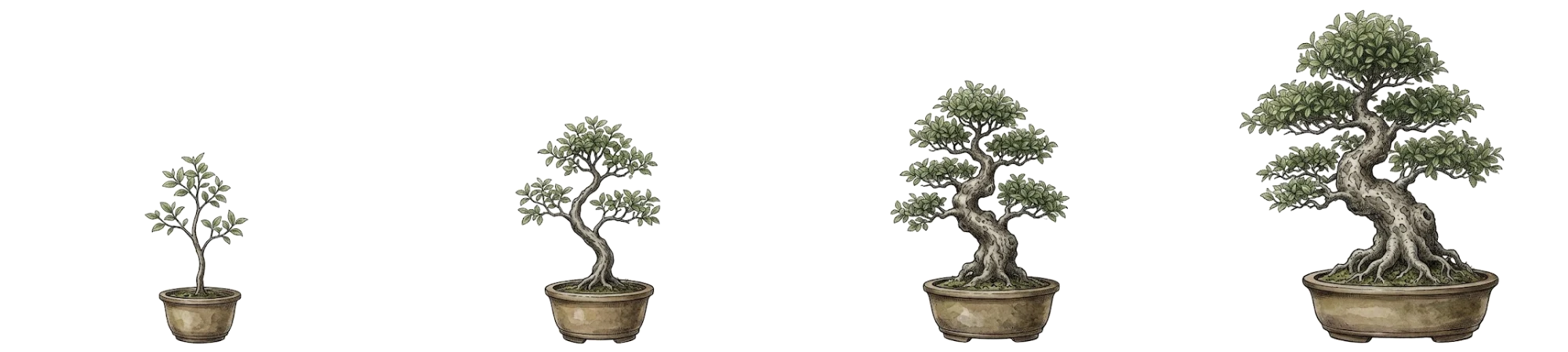
An approximate guide, assuming continued cultivation and pruning.
When you bring it home
- Unpack it today. Take the tree out of the box and remove any plastic or wrapping from the pot.
- Find it a spot. Give it plenty of light, away from heaters and draughts.
- Feel the soil before watering. If the top layer is still damp, wait.
- Put back any soil that has shifted. Spread it out without piling it against the trunk. It is normal for thick roots to show.
- Check it doesn’t wobble. If it moves in the pot, secure it so the roots can take hold.
- Leave it alone. For the first few weeks, don’t repot, prune or feed it.
If something looks wrong
Scale insects: small bumps or cottony tufts on branches and the undersides of leaves, with sticky honeydew. More common on weak trees and in dry indoor air.
Spider mites: pale speckling on the leaves and fine webbing. Dry air from central heating encourages them.
Leaf drop: almost always caused by overwatering, too little light or a sudden change of position.
If in doubt, ask before treating.
With dogs and cats Toxic
The ASPCA lists it as toxic to dogs and cats. Keep it out of their reach and, if they chew it, call your vet.
Source: ASPCA, toxic and non-toxic plants for dogs · ASPCA, toxic and non-toxic plants for cats. Checked on 17 November 2026.